.png)
When sourcing stainless steel pipes from India for critical oil, gas, pharmaceutical, and heavy engineering applications, procurement teams must look beyond basic dimensions. With global supply chain fluctuations and shifting LME nickel prices in 2026, verifying a supplier's mill capabilities, ASTM compliance, and export logistics is mandatory to prevent project delays.
Below is our complete supplier capability matrix, vendor verification checklist, and grade selection guide to help EPC contractors and procurement heads make data-backed purchasing decisions.
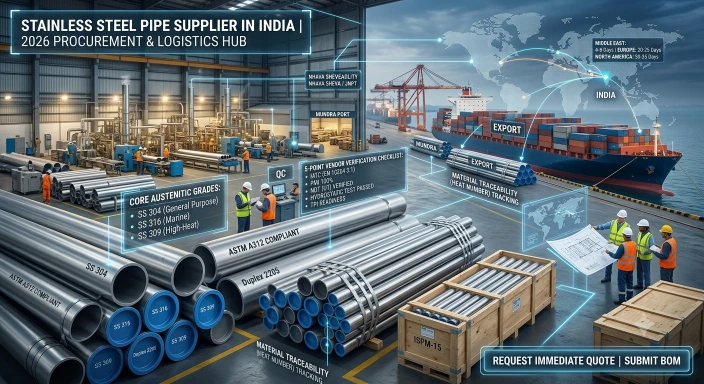
Core Austenitic Grade Selection & Live Inventory
Selecting the correct austenitic stainless steel grade prevents catastrophic failures like stress-corrosion cracking and carbide precipitation. As a premier stockist, we maintain an extensive inventory tailored to specific thermal and chemical environments.
The 304 Series: General Purpose & Structural Applications
Grade 304 is the baseline for Indian manufacturing, offering excellent formability and oxidation resistance. However, precise carbon control is required based on the welding and temperature demands of your project:
- For standard dairy, food processing, and architectural frameworks, we supply standard Stainless Steel 304 Pipes.
- For heavy-gauge welding applications where avoiding intergranular corrosion and carbide precipitation is critical, specify our Stainless Steel 304L Pipes.
- If your structural application operates in high-temperature environments (500°C to 800°C), you require the elevated carbon content found in our Stainless Steel 304H Pipes to maintain yield strength.
The 309 Series: High-Heat & Furnace Applications
When temperatures exceed the limits of 304, the 309 series provides superior oxidation resistance due to its higher chromium and nickel composition. We stock Stainless Steel 309 Pipes specifically for refinery equipment, catalytic converters, and radiant tubes. For extreme furnace environments requiring maximum resistance to creep deformation under load, we supply specialized Stainless Steel 309H Pipes.
The 316 Series: Marine & High-Chloride Environments
In environments susceptible to pitting and crevice corrosion—such as coastal marine facilities, wastewater treatment, and chemical processing—the addition of molybdenum is non-negotiable. For environments requiring ultimate corrosion resistance, we supply a full range of Stainless Steel 316 / 316L / 316Ti / 316H Pipes, including titanium-stabilized variants designed for prolonged high-temperature exposure without sensitization.
Complete Supply Capabilities & Size Range
Unlike traders who rely on secondary markets, a direct supplier must offer a comprehensive size range and manufacturing methodologies. Note: Seamless (extruded) pipes typically carry a 20-30% premium over ERW (welded) variants due to their superior pressure ratings and structural uniformity.
| Specification | Range / Details |
|---|---|
| Standards Compliance | ASTM A312, A213, A269, A358 / ASME SA312 |
| Outside Diameter (OD) | 1/2" NB to 48" NB |
| Wall Thickness (Schedules) | SCH 5S, 10S, 40S, 80S, 160, XXS |
| Manufacturing Processes | Seamless, ERW, EFW, Fabricated |
| End Finishes | Plain End, Beveled End, Threaded |
5-Point Supplier Verification Checklist (NDT & MTCs)
Never issue a Purchase Order without confirming the supplier's quality control framework. We provide the following documentation and testing with every dispatch to ensure total traceability:
- Mill Test Certificates (MTC): We supply EN 10204 3.1 / 3.2 certificates verifying chemical composition and mechanical properties for every batch.
- Positive Material Identification (PMI): 100% PMI testing guarantees that the exact alloy grade ordered is the one delivered.
- Non-Destructive Testing (NDT): We utilize Ultrasonic Testing (UT) to detect internal flaws that visual inspections miss.
- Hydrostatic Testing: All welded (ERW/EFW) pipes undergo high-pressure hydrostatic testing to guarantee zero leakages under working conditions.
- Third-Party Inspection (TPI): Our inventory is always open for inspection by global agencies like SGS, TUV, or Lloyd's Register.
Indian Export Logistics & Port Proximity
A supplier's price means nothing if their logistics cause project delays or transit damage. We manage an end-to-end global export pipeline out of Maharashtra and Gujarat:
- Port Proximity: Our primary dispatch hubs are located within hours of Nhava Sheva Port (JNPT) in Mumbai and Mundra Port in Gujarat, ensuring rapid customs clearance and loading.
- Export Packaging Standards: To prevent salt-water corrosion and transit impacts, all export shipments are fitted with plastic end caps, bundled with steel strips, and packed in fumigated wooden crates compliance with ISPM-15 standards.
Estimated Global Transit Times
- Middle East (UAE/Saudi Arabia): 4–8 days
- Europe (UK/Germany): 20–25 days
- North America: 30–35 days
Current Stainless Steel Pipe Price Index (India - 2026)
Disclaimer: Stainless steel pricing is volatile and directly tied to LME (London Metal Exchange) Nickel and Chromium rates. The figures below are baseline estimates for standard seamless/welded pipes in the Indian market as of mid-2026. Custom schedules (like XXS) or large-diameter seamless will alter the per-kg rate.
| Material Grade | Estimated Price Bracket (per kg) |
|---|---|
| SS 304 / 304L | ₹190 – ₹280 / kg |
| SS 316 / 316L | ₹300 – ₹420 / kg |
| SS 309 / 310S | ₹450 – ₹600 / kg |
| Duplex (2205) | ₹650 – ₹850 / kg |
Submit Your BOM for an Immediate Quote
Do you need exact pricing and live stock availability for your upcoming project? Upload your Bill of Materials (BOM) or specific technical requirements. Our metallurgy and sales team will review your required ASTM standards, schedules, and lengths to provide a comprehensive, localized quote within 24 hours.
Contact Sales & Request Quote →